Graph-based Transaction tracing
The transaction subgraph spiders aim at collecting the transactions (or token transfers) related to specific source addresses or transactions. BlockchainSpider provides the following built-in strategies:
BlockchainSpider.strategies.txs.BFS: Breadth-First Search.BlockchainSpider.strategies.txs.Poison: taint analysis that only propagates along outgoing transfers.BlockchainSpider.strategies.txs.Haircut: taint analysis that allocates pollution by transfer amount.BlockchainSpider.strategies.txs.APPR: Approximate Personalized PageRank.BlockchainSpider.strategies.txs.TTRBase: Transaction Tracing Rank with uniform edge distribution.BlockchainSpider.strategies.txs.TTRWeight: Transaction Tracing Rank with value-weighted distribution.BlockchainSpider.strategies.txs.TTRTime: time-aware Transaction Tracing Rank.BlockchainSpider.strategies.txs.TTRRedirect: redirect-aware and token-aware Transaction Tracing Rank.
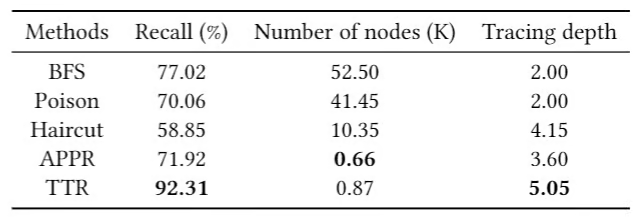
The performance comparison of the above strategies is as follows:
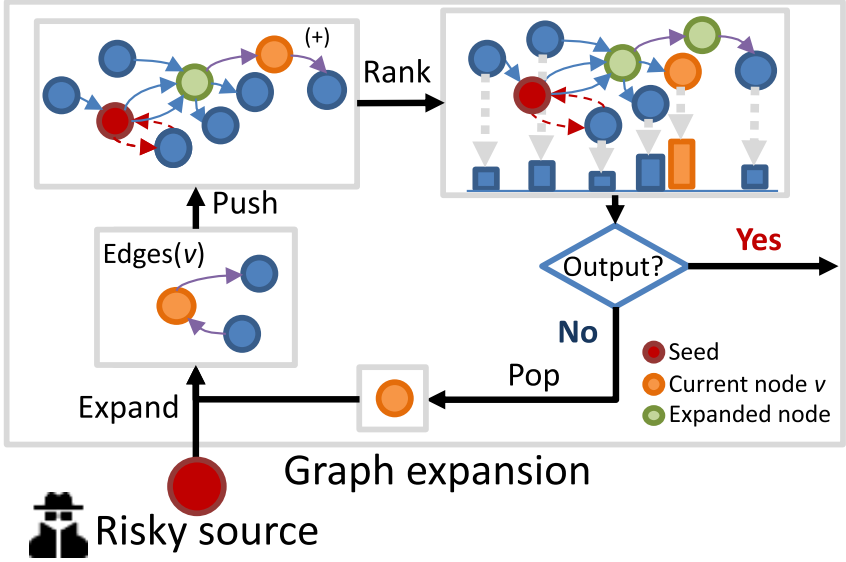
All transaction subgraph spiders are implemented based on the graph expansion framework, which has four core operations:
- Expand: collects all transactions related to a given address or transaction.
- Push: merges the collected transactions to the subgraph.
- Rank: computes the relevance of addresses in the subgraph to the source node.
- Pop: select a node for expanding.
The implementation of different strategies are as follows:
| Strategy | Push & Rank | Pop & Expand |
|---|---|---|
| BFS | Add expanded neighbors to a queue | Select an unexpanded node in the header of the queue for expanding |
| Poison | Add expanded out-degree neighbors to a queue | Select an unexpanded node in the header of the queue for expanding |
| Haircut | Allocate the pollution value to neighbors according to the edge weight | Select an unexpanded node with the highest pollution for expanding |
| APPR | Use the local push procedure for expanded neighbors | Select a node with the highest residual for expanding |
| TTR family | Use the TTR local push procedure for expanded neighbors | Select a node with the highest residual for expanding |
Note: for more details, please refer to the paper: TRacer: Scalable Graph-Based Transaction Tracing for Account-Based Blockchain Trading Systems.
How to pass strategy parameters
All strategy parameters are passed through spider arguments with -a.
For example, if you use BlockchainSpider.strategies.txs.BFS with depth=3, the command is:
scrapy crawl txs.blockscan \
-a source=0xYourSourceAddress \
-a apikeys=YourApiKey1,YourApiKey2 \
-a strategy=BlockchainSpider.strategies.txs.BFS \
-a depth=3
The same strategy arguments also work for txs.tronscan and txs.blockchaininfo.
Only the spider-specific arguments such as apikeys, endpoint, enable, or time/block range are different.
Strategy parameters
BlockchainSpider.strategies.txs.BFS
Breadth-first expansion over both incoming and outgoing neighbors.
| Parameter | Type | Default | Description |
|---|---|---|---|
depth |
int | 2 |
Maximum expansion depth. depth=1 means only direct neighbors of the source node are expanded. |
Example:
scrapy crawl txs.blockscan \
-a source=0xYourSourceAddress \
-a apikeys=YourApiKey1,YourApiKey2 \
-a strategy=BlockchainSpider.strategies.txs.BFS \
-a depth=2
BlockchainSpider.strategies.txs.Poison
A simple taint propagation strategy. Unlike BFS, it only follows outgoing transfers from the current node.
| Parameter | Type | Default | Description |
|---|---|---|---|
depth |
int | 2 |
Maximum forward tracing depth. Only outgoing neighbors are added at each step. |
Example:
scrapy crawl txs.blockscan \
-a source=0xYourSourceAddress \
-a apikeys=YourApiKey1,YourApiKey2 \
-a strategy=BlockchainSpider.strategies.txs.Poison \
-a depth=3
BlockchainSpider.strategies.txs.Haircut
Taint analysis with value allocation. For each expanded node, the node weight is distributed to outgoing neighbors in proportion to transfer value.
| Parameter | Type | Default | Description |
|---|---|---|---|
min_weight |
float | 1e-3 |
Minimum pollution weight required for a node to be expanded. The value must be between 0 and 1. Smaller values usually produce larger subgraphs. |
Example:
scrapy crawl txs.blockscan \
-a source=0xYourSourceAddress \
-a apikeys=YourApiKey1,YourApiKey2 \
-a strategy=BlockchainSpider.strategies.txs.Haircut \
-a min_weight=0.005
BlockchainSpider.strategies.txs.APPR
Approximate Personalized PageRank on the transaction subgraph.
It maintains a rank vector p and a residual vector r, and always expands the node with the largest residual.
| Parameter | Type | Default | Description |
|---|---|---|---|
alpha |
float | 0.15 |
Probability mass retained on the current node when pushing residuals. The value must be between 0 and 1. Larger values concentrate more score near the source node. |
epsilon |
float | 1e-5 |
Residual threshold for stopping expansion. The value must be between 0 and 1. Smaller values usually expand more nodes and cost more time. |
Example:
scrapy crawl txs.blockscan \
-a source=0xYourSourceAddress \
-a apikeys=YourApiKey1,YourApiKey2 \
-a strategy=BlockchainSpider.strategies.txs.APPR \
-a alpha=0.2 \
-a epsilon=1e-6
BlockchainSpider.strategies.txs.TTRBase
The basic Transaction Tracing Rank strategy. It splits residuals to outgoing and incoming neighbors by edge count.
| Parameter | Type | Default | Description |
|---|---|---|---|
alpha |
float | 0.15 |
Portion of residual converted into final score on the current node at each push. |
beta |
float | 0.8 |
Portion of the remaining residual propagated to outgoing neighbors. The rest, 1 - beta, is propagated to incoming neighbors. |
epsilon |
float | 1e-3 |
Residual threshold for stopping expansion. Smaller values usually expand more nodes. |
Example:
scrapy crawl txs.blockscan \
-a source=0xYourSourceAddress \
-a apikeys=YourApiKey1,YourApiKey2 \
-a strategy=BlockchainSpider.strategies.txs.TTRBase \
-a alpha=0.15 \
-a beta=0.8 \
-a epsilon=1e-4
BlockchainSpider.strategies.txs.TTRWeight
A value-weighted TTR variant.
Compared with TTRBase, residuals are distributed according to transfer amount instead of edge count.
| Parameter | Type | Default | Description |
|---|---|---|---|
alpha |
float | 0.15 |
Portion of residual converted into final score on the current node at each push. |
beta |
float | 0.8 |
Portion of the remaining residual propagated to outgoing neighbors. The rest is propagated to incoming neighbors. |
epsilon |
float | 1e-3 |
Residual threshold for stopping expansion. Smaller values usually expand more nodes. |
Example:
scrapy crawl txs.blockscan \
-a source=0xYourSourceAddress \
-a apikeys=YourApiKey1,YourApiKey2 \
-a strategy=BlockchainSpider.strategies.txs.TTRWeight \
-a alpha=0.15 \
-a beta=0.9 \
-a epsilon=1e-4
BlockchainSpider.strategies.txs.TTRTime
A time-aware TTR variant. Residuals are propagated according to transaction time order, which is useful when you care about temporal consistency.
| Parameter | Type | Default | Description |
|---|---|---|---|
alpha |
float | 0.15 |
Portion of residual converted into final score on the current node at each push. |
beta |
float | 0.8 |
Portion of the remaining residual propagated to later outgoing transfers. The rest is propagated to earlier incoming transfers. |
epsilon |
float | 1e-3 |
Residual threshold for stopping expansion. Smaller values usually expand more nodes. |
Example:
scrapy crawl txs.blockscan \
-a source=0xYourSourceAddress \
-a apikeys=YourApiKey1,YourApiKey2 \
-a strategy=BlockchainSpider.strategies.txs.TTRTime \
-a alpha=0.15 \
-a beta=0.8 \
-a epsilon=1e-4
BlockchainSpider.strategies.txs.TTRRedirect
A redirect-aware TTR variant. It aggregates transfers with the same transaction hash and keeps token symbols during propagation, which makes it more suitable for mixed-token fund flow analysis.
| Parameter | Type | Default | Description |
|---|---|---|---|
alpha |
float | 0.15 |
Portion of residual converted into final score on the current node at each push. |
beta |
float | 0.8 |
Portion of the remaining residual propagated to outgoing transfers. The rest is propagated to incoming transfers. |
epsilon |
float | 1e-3 |
Residual threshold for stopping expansion. It is also used internally to stop overly fine-grained redirect splitting. |
Example:
scrapy crawl txs.blockscan \
-a source=0xYourSourceAddress \
-a apikeys=YourApiKey1,YourApiKey2 \
-a strategy=BlockchainSpider.strategies.txs.TTRRedirect \
-a alpha=0.15 \
-a beta=0.8 \
-a epsilon=1e-4 \
-a enable=BlockchainSpider.middlewares.txs.blockscan.ExternalTransferMiddleware,BlockchainSpider.middlewares.txs.blockscan.Token20TransferMiddleware
Parameter selection suggestions
- Use
BFSwhen you need a simple baseline and a controllable hop limit. - Use
Poisonwhen you mainly care about forward fund flow from the source node. - Use
Haircutwhen you want taint dilution by transfer amount. - Use
APPRwhen you need a ranking-oriented strategy that concentrates score near the source node. - Use
TTRBaseorTTRWeightwhen you need bidirectional tracing with residual ranking. - Use
TTRTimewhen transaction order matters. - Use
TTRRedirectwhen token type and intra-transaction redirect behavior matter.
Notes
BFSandPoisonmainly usedepthto control expansion size.Haircutmainly usesmin_weightto control expansion size.APPRand theTTRfamily mainly useepsilonto control expansion size.- Smaller
epsilonormin_weightusually leads to more nodes being expanded and higher runtime. - On account-based chains, strategies consume normalized transfer edges with fields such as
from,to,value,timeStamp, andsymbol. TTRRedirectcan automatically handle different token types during propagation, so in practice it may collect token transfers beyond a strictallowed_tokensfilter.
Customise your own strategy
You can implement your own strategy by inheriting the BlockchainSpider.strategies.txs.PushPopModel class.
Here is the simplest example, in which for each Ethereum address, we track only the output money transfer with the
largest Ether value.
First, create a new file mystg.py in the root directory of the project and declare a PushPopModel class:
from typing import Any, Dict, Tuple
from BlockchainSpider.strategies.txs import PushPopModel


class MyStrategy(PushPopModel):
    def __init__(self, source, **kwargs):
        super().__init__(source, **kwargs)
        self.to_be_vis = set()

    def push(self, node, edges: list, **kwargs):
        # node is the address of the current node
        # edges is a list of money transfers related to the current address
        # each edge is a dict with fields adapted from TransferItem, e.g. `AccountTransferItem`
        # please refer to `BlockchainSpider/items/subgraph.py`
        edges = [edge for edge in edges if edge['address_from'] == node]
        if len(edges) == 0:
            return
        edges.sort(key=lambda x: int(x['value']), reverse=True)
        self.to_be_vis.add(edges[0]['address_to'])

    def pop(self) -> Tuple[Any, Dict]:
        if len(self.to_be_vis) == 0:
            return None, {}
        node = self.to_be_vis.pop()

        # the returned dictionary will be used as kwargs for the next push
        # we do not need to pass context here, so return an empty dict
        return node, {}

    def get_context_snapshot(self) -> Dict:
        return {'to be visited': self.to_be_vis}

    def get_node_rank(self) -> Dict:
        return {}
Next, start the txs.blockscan spider and mount the new strategy:
scrapy crawl txs.blockscan \
-a source=0xYourSourceAddress \
-a apikeys=YourApiKey1,YourApiKey2 \
-a strategy=mystg.MyStrategy